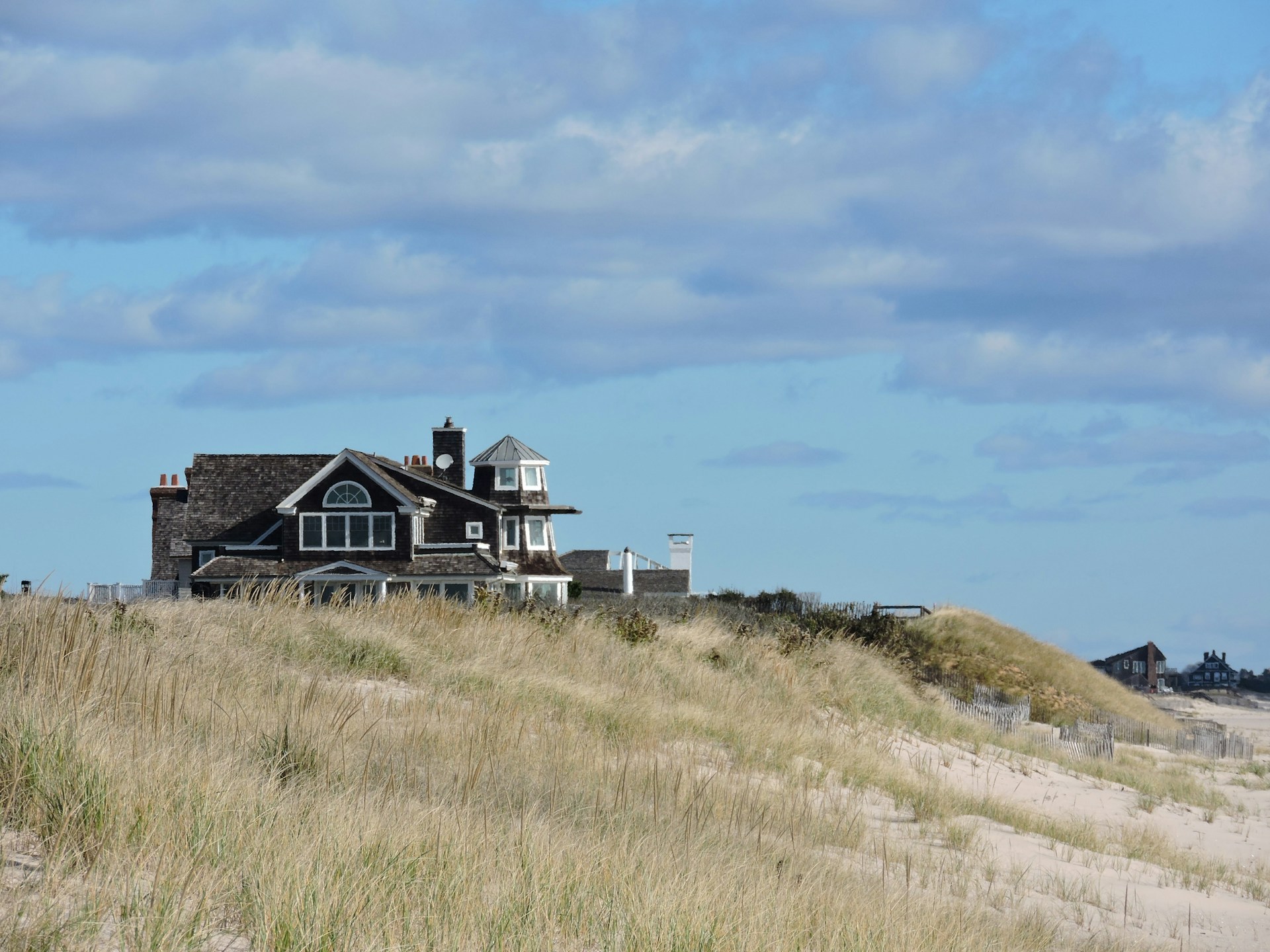
The following story was written in 2009 for Margaret McMullan’s Short Fiction course as part of an assignment to pull inspiration from a magazine photo. Barnaby Roper’s photos from the March 2009 issue of Esquire provided the inspiration.
“I don’t care what you say,” Mollie said, “Your dad’s the most intimidating person I’ve ever met.” She was in the shower, scrubbing away the grit of salt and sand from her skin after a long afternoon by the shore. “When we got here, he just looked at me like I didn’t belong.”
“I think it was more of a surprise that I actually came home, let alone brought you along. I haven’t been home since Mom’s funeral, remember?”
He never talked about his mother or how she died. It happened before the two of them met. Mollie only knew that James rarely called his father. When he did, their conversations were quick and hardly cordial. The latest of these dealt with—as far as she knew—the sale of the house they were staying in during their vacation. It was to be a topic of discussion at tonight’s dinner.
She thought about the first time she met James’s father, just the day before. When James and Mollie pulled up in front of the old cottage—she drove, as usual—he was busy stacking wood. Tall and slim, much like James, but his hair was gray, and the wrinkles of his face suggested a life of hard work and intensity. He needed a shave. A cigarette, spent almost to the filter, hung between his lips. Mollie thought his gaze only intensified more when James stepped out of the passenger side.
“So, you decided to come after all,” he called from across the lawn. He stayed close to the house, leaning against a pile of wood.
“Hi, Dad,” James said. He looked nervous as he walked toward his father, like he might have just done something wrong by coming.
“Who’s this?” Stephen turned his attention to Mollie. She felt those intense eyes upon her and instantly understood James’s discomfort.
“Mollie. Mollie Cartwright,” she said.
“Stephen Adams. Welcome to Cresthaven, Mollie. I’m sure James has told you quite a bit about it.” His voice was pleasant. He extended his hand and warmly shook hers.
“Some,” she said.
James had told her about his childhood in Cresthaven. About how his father taught him to swim in the ocean, and then how to sail. He had described in vivid detail the first time he and his friends drank cheap beer at a bonfire—and how his father punched him in the mouth later that night for making so much noise coming in the house, upsetting his mother. It was one of the few conflicts between them James seemed to recall with any fondness or humor. More importantly, it was one of the few times he made mention of his mother. One thing Mollie realized early on was just how guarded James was about certain aspects of his life. The phone calls were one example. She never asked about them, and James chose not to volunteer information.
The shower curtain being pulled aside startled her. James sat down on a bench next to the shower, still in his clothes. She was worried at first about the water getting out onto the floor and turned to protest. But the shower’s tight spray kept any water from escaping.
“Hey, daydreamer,” he laughed. “What’s got you so quiet all of a sudden?”
“Nothing, really. Just thinking.” She felt a little strange as James sat there, watching her while she rinsed the conditioner from her hair.
“About what? Seems like you’ve had a lot on your mind since we got here. You still worried about Dad?”
“No. Just thinking about what we’ll have for dinner.”
“Don’t worry too much. I think Dad said he was going to grill salmon tonight,” James said. “Now, if you don’t mind, I’d like to get cleaned up too. I mean, as long as you’re willing to leave me some hot water.”
“Here, want some?” She splashed him with a handful before stepping out of the stall. She grabbed a nearby towel and began to dry herself as James stepped out of sight behind the curtain and tossed his swim trunks and shirt aside. They landed on the bench with a wet slap.
“I’m going into the bedroom to finish getting ready. Your dad isn’t going to come home early and bump into me in the hallway, is he?”
“Nah. He runs his boat on a tight schedule. They’re just now starting to head back to shore.”
Mollie closed the bathroom door behind her and left James to his own devices. As she walked down the hallway and up the stairs to the guest bedroom, Mollie considered the house. It was completely different from anything she was expecting. James had told her about it on the drive from Philadelphia. His parents bought it in 1970 from an old sailor’s family after the sailor needed to be put in a nursing home. Something that had surprised her about the house was its size. It was big, a solid grey house with wooden siding. It had an amazing view of an open field that stretched for what looked like an acre. Behind the house, a rocky path wound down to the shore. The beach itself was fairly secluded and, she had to admit, close to perfect.
The interior of the house was beautiful, strikingly modern despite its outward appearance. Stephen had spent quite a bit of time and money remodeling it before James’s mother died. The kitchen felt large and airy and opened to a wide deck overlooking the ocean. Adjacent to the kitchen was a large living room with less furniture than one might imagine. An old sofa, still in good condition, complimented a large, padded recliner. The television in the room hung upon the wall. Both kitchen and living room shared a cathedral ceiling, into which a couple of skylights had been cut.
One thing Mollie had noticed was a distinct lack of femininity. All its interior details, from the paint upon the walls to its furniture, were obvious features of function. Much like the living room, the kitchen décor was just as Spartan. Save for the counters and appliances, only a simple table and chairs occupied the room. Mollie got the impression James’s father spent the barest amount of time here since his wife’s death.
There were four bedrooms, just two of which she had seen. James had shown her his old room, which had been turned in the intervening years since his departure into a small office or study. A massive antique bookcase hugged one wall; its shelves filled with books on subjects from sailing to woodworking. A matching desk on the opposite wall held a computer and various files, immaculately organized. James told her his father was extremely diligent when it came to keeping track of trends in local fishing. If she wanted to dig deep enough, she could probably find records of how many fish his father had caught in 1973, or a chart of which spots in the bay to avoid. Mollie was impressed but somewhat disappointed. Much to her annoyance, James had not inherited that same attention to detail.
Opposite the office was the locked door to his father’s room. A small staircase at the end of the hall led up to their guest bedroom, the bathroom, and one other room opposite theirs with a closed door.
She didn’t ask James about it before but was curious about the room’s contents. She now wrapped her hand around the knob and twisted but found no give. Mollie turned around to walk into the guest bedroom, but not before taking one more look at the locked door and shrugging.
Mollie could still hear the water of the shower running, even from their bedroom. She sighed as she looked to the small closet in which she had hung their clothes the night before. Reaching inside, she pulled out a simple cable sweater and jeans. It certainly wasn’t sweater weather during the day, but she packed it after James insisted the nights were always a little crisp. She thought for a moment, and then grabbed a lightweight Oxford-cloth button-down to layer underneath. She slid first into a nondescript pair of cotton underwear, then the Levi’s. Mollie briefly examined her body in the mirror, posing.
James’ voice startled her.
“Like what you see there? I know I do.” He walked into the room. He hadn’t shaved and his hair was still a bit messy. A towel was wrapped around his hips. His muscular torso, disheveled hair, and unkempt beard made her think of his father. She could see a bit of that ruggedness left over in James. This new notion made her heart flutter a bit.
“I like what I’m looking at a lot more,” she said, taking a step toward him. Mollie wished she hadn’t already put her Levi’s on. She leaned in to kiss him but wanted more than a kiss. They were pressed for time. Mollie wondered suddenly how thick the walls in the old house were.
“Hey, now. Don’t start something you won’t finish,” James said. “It’s not fair.” He tossed aside the towel and turned away, reaching into the closet for his own clothes.
“What makes you think I won’t finish it?” She moved behind him and wrapped her arms around his waist. She loved the feel of his bare skin against her arms.
“We just took showers,” James sighed.
“What time does your Dad get home?” She stole a glance at the clock and slid her hand around his hip to his inner thigh.
“Six,” he groaned.
The hands on the clock face betrayed an hour and a half of spare time. Plenty, she decided. Feeling mischievous, Mollie moved her hand an inch.
James trembled as her fingertips grazed him, and abruptly turned toward her. “It’ll have to be quick,” he said, kissing just beneath her ear lobe. His breath was hot against her skin.
“But not too quick,” she said. “We have plenty of time.” She pulled him back toward the bed as his thumb popped the buttons on her fly open. Seconds later, the Levi’s were a crumpled pile on the floor. The two of them were a tangled heap on the bed, and Mollie gasped as the backs of her knees wrapped tightly around James’s hips.
Stepping back in front of the mirror, Mollie reached over for her shirt and slipped her arms inside its sleeves. Buttoning it, she watched James dress. He wore a simple striped sweater and faded cotton trousers. She was often jealous at how effortless style came to him. James Adams looked damn good to her no matter what he wore. Just as he finished adjusting the cuffs of his sleeves, Mollie desperately wanted to peel the sweater off him again. She pulled her own sweater over her head and tugged down to adjust the layers.
“Make-up or no?” She studied her face in the mirror, turning it this way and that to look at different angles.
“We’re just eating dinner here. I mean, you don’t need to impress Dad or anything.”
“I didn’t know if we were going out after dinner.” She leaned in closer and swept a brush over her cheeks.
“I hadn’t really planned on it. I mean, Rory might give me a call later in the evening, but it’s never really a sure bet with him.”
One of the doors downstairs opened and slammed shut. James looked out the window and turned to Mollie. “Dad’s home,” he said, and slipped his wristwatch over his hand. “Five fifty-nine. Right on schedule.”
“Are you nervous?” she wrapped her arms around his waist.
“About what?” James placed his chin on the top of her head.
“Telling your dad, you’re thinking about moving back. I mean, what do you think he’ll say?” Mollie pulled her face back from against his chest and looked up at him.
“Hard to say. Maybe he’ll think it’s a good idea. Maybe he’ll hate it. What do you think about it? Moving here, I mean?”
Mollie shrugged. “It wouldn’t be permanent,” she said. “Right?”
James didn’t respond beyond a noncommittal grunt.
“So how did you two meet?” Stephen asked. He delicately pushed his knife into the side of a grilled fish fillet before spearing it with his fork. “He hasn’t really told me much about you.”
Mollie laughed easily. She’d told this story dozens of times to friends, so it came naturally. “Well, I’m in real estate. I’m giving an open house one day and I notice in the back of the group this nice-looking guy taking down all kinds of notes. He’s pretty much writing down everything I say.” She paused to take a bite out of her own fish.
“It wasn’t everything,” James interjected.
“It seemed like it,” Mollie said, “Anyway, he comes up to me after the tour to ask me questions. I figure it’s about the house. Instead, he wants to know my phone number.”
“For real estate purposes!”
“Mmhmm. Well, either way I decided it couldn’t hurt. I give him my number and he leaves. He doesn’t even ask about the house.” Mollie rolled her eyes.
James’s mouth was full of food, but that didn’t stop him from protesting. “I didn’t like that one.”
“And that’s why a few days later you called me and asked me to meet for coffee? You wanted to know about other houses or apartments? That’s it?”
“Well, yeah. Among other things.”
Stephen suddenly reminded them he was present. “I can’t really imagine James in a suit for longer than ten minutes. He was always getting his clothes filthy as a kid. Sarah could barely keep up when it came time to do laundry.”
Mollie pictured his mother, suddenly. She had seen photos before, in their apartment as well as on the walls of Cresthaven. She was a beautiful woman, with a kind smile and wise eyes. In all the photos Mollie saw, Sarah’s hair was long, but she kept it pulled back. She wondered more about this woman she would never meet, how similar she might be to Mollie—and how much of her was found in James’s temperament.
“Well, there’s not really an opportunity to get dirty in Philadelphia. Besides, I can’t meet with clients wearing tattered jeans and flannel shirts. I had to grow out of that.” James took another bite.
Mollie laughed. “Just how much of a trouble maker were you?”
James’s father tried to stifle a laugh. “Enough of one that I spent my fair share of time down at the police post cancelling out stolen boat reports.”
“You used to steal boats?”
“Just Dad’s.”
“And it was a damn good thing you never wrecked it when you did. I’d wake up in the middle of the night and just knew something wasn’t right. I’d look out the window and see lights on in the boathouse. That’s how I’d know. The first few times I was really pissed, but eventually I figured out what was going on. James would ‘borrow’ the boat for little trips with girls in town. I couldn’t blame him too much. I did the same thing with Sarah when we were kids.”
Both James and his father sighed. Mollie got the impression that both men missed her like hell, but rarely ever talked about her, and especially to one another. As dinner went on, she took notice that each time Stephen mentioned his late wife, his son would tense up. She was certain his father noticed it as well.
After they ate, Mollie insisted on doing the dishes. She stood at the sink, quietly scrubbing away the excess crumbs and bits of food from the plates, pans, and silverware. James and his father sat at the table, drinking together and sharing gossip about townspeople, most of whom Mollie had never heard of.
The conversation eventually turned toward the house and Stephen’s plans for it. Apparently, he had already made offers to a few of his friends based on research he’d done on the internet. Throughout the conversation, Mollie snuck glances at James for any sign of anger. To his credit, she thought, he played it relatively cool. Only during a lull in the conversation did he make his intent known.
“I’d like to buy the house,” he said quietly.
James’s father sipped the dark liquor in his glass and looked across the table at James in surprise. “You want to do what?” he asked.
“I’d like to buy the house, if you’ll consider my offer.” James took another sip of his Corona. Mollie, finishing the last of the cleaning, turned and watched as a lime wedge inside the bottle bobbed up and down.
“Why would you want it? You haven’t been home for five years.”
“That’s something I was thinking about. I mean, I’d definitely like to come around a lot more, especially during the summers. Maybe even move back here. Most of my work is internet-related these days, anyway, so it doesn’t really matter where I live. It wouldn’t be a terrible commute to Philly by train.”
Stephen took a bigger gulp of whiskey and turned his attention toward Mollie. “What’s your take on this?”
She quietly cleared her throat before saying, “He’s talked to me about this place a lot.”
“Is that right?” Stephen leaned back in his chair and took another drink. “Well, in your expert opinion, how much do you think it would go for?”
“I’ll give you $850,000,” James declared. Mollie was surprised—she didn’t think it was worth that much but didn’t dare interject in what was such a sore subject.
“Hmph. That’s a lot of money, son.” Stephen raised his eyebrows. “Why do you want the house so badly? You leave for years without so much as a word, and come back now?”
James swallowed hard. “Because I think she’d want it to stay in the family instead of going to strangers.”
Stephen glared at his son and leaned forward. “Don’t even start with this. You weren’t there. I won’t let you completely ruin dinner.”
“How? By being honest for once and making you admit what happened? That’s why you’re selling the house. You can’t stand living here with her ghost. You can’t stand the guilt anymore, can you?” James was almost on his feet, glaring daggers at their host.
Mollie raised her eyebrows. She’d heard James use that tone before, during one particularly rough fight between the two of them a few months ago. She didn’t remember what caused it, but did recall just how afraid she was when he stormed out of their shared apartment in Philadelphia. She was worried he wouldn’t come home.
“You’re right. That’s exactly why.”
“What?” James sat down, all that sudden angry confidence rushing out of him like a balloon. It seemed to Mollie he was prepared for a more protracted argument and had geared himself up, in her mind, for something much more dynamic.
“Every time you look at me, I can see it. You think I’m responsible. Maybe I am. But you don’t have any right to accuse me of things you know absolutely nothing about. Until you have to live alone in this house with nothing to listen to but your own footsteps, you don’t have a goddamn right to question what I do, understand?”
James swallowed hard, as if his legs had been cut from beneath him.
Stephen didn’t say anything for a few moments. He abruptly pushed his chair back and stood. “I have a few things that need to be done in town. I’ll be home later.” He stormed out the kitchen door. Moments later, Mollie heard the sound of a truck engine revving followed by the crunch of tires on gravel.
Mollie looked at James. He looked drained of almost all energy. She saw it as something of an opening, and considered pressing the subject. Asking the questions she could never ask before. Maybe she would tell James to explain what happened five years ago, and what had caused such an impassable fissure between these two men.
“Are you okay?” she asked instead.
“Just like him. Always runs away when something gets tough.” James went to the fridge and pulled out another beer. “Want one?” He turned back toward Mollie, who had taken a seat at the table.
“Sure,” she sighed.
He sat back down and popped the cap from the bottle before sliding it carefully across to her. She took a drink. Neither of them spoke. In the absence of conversation, Mollie heard the waves crash against the rocks beyond the deck. It was peaceful in a way she imagined the rest of their trip would not be.
“So what are we going to do now?” James asked.
“Get a hotel room?” It came out like a joke, but Mollie was serious. She doubted getting through the rest of the night without a fight was possible.
“Funny.” James closed his eyes and hummed. “We could go bowling. We could go to the bar. It’s a small town, so there’s not much of anything to do.”
“I’m not very good at bowling.”
“I’m not great, either. But I need to get out of the house for a while.”
“Then we’ll go bowling.” Mollie stood up and pushed the chair in. Let me go get my keys?”
“I’ll be out in the truck.” James took another long swig from the bottle and stepped toward the door.
The bowling alley was a joke, but it was just what James needed.
Mollie watched as he bowled strike after strike—more of that false modesty she fell for back home—and sighed. Without Stephen’s presence to make her lover tense, James’s frown fell away. After the third frame, he began to smile. In the seventh, she heard him laugh. By the time the game was over, he’d returned to his former self.
Mollie dreaded going back to the house, with its secrets and its anger, and with the ghost of the woman she felt herself being compared to—even though no words of the sort had been spoken. If moving to James’s boyhood home meant that kind of misery, she could leave the whole damned ocean, the beach, and the town. Take her back to the city, she thought, and just pretend this place didn’t exist.
By the time the two of them had gotten back to the house after their outing, James’s mood had improved considerably. He didn’t speak much of his father, or of Sarah. Mollie thought about broaching the subject of leaving early that next morning, if only to avoid another explosion of an argument. But she knew it was important for James to make his peace with the place—if it took another day or two, what would it hurt? Before too long, they would be back home in their own bed—and all this unpleasantness would be a distant memory.
They pulled into the driveway and found Stephen’s truck still absent, which meant they would have some more time alone. But Mollie was so exhausted—from the sunbathing and the dinner argument and bowling—that she insisted on retiring to bed soon after they arrived. James didn’t argue, although he said he wanted to do some reading. The two of them crept up the stairs and got ready for bed without much other conversation. Mollie was asleep before James had even finished brushing his teeth.
Mollie reached her arm across the bed to find only a warm spot where James had been before she fell asleep. She opened her eyes and looked at the alarm clock. Its bright red face told her it was late. Where had James gone? To the bathroom, perhaps? She assumed he would be back soon and tried to close her eyes and return to sleep, but her thoughts began to tumble and overlap, and she knew she’d be awake for a while.
Suddenly, she rolled over and looked up at the ceiling. She thought about the photo of James’s mother and the conversation at the table. For as prominent a figure as she was in James’s life, Mollie knew almost nothing about her. She knew she had beautiful, of course, and a talented artist, but other details—the wise things she might have said, foods she cooked for James when he was younger—weren’t part of what he chose to share.
She heard voices across the hall. They echoed behind the locked door. She could make out James’s voice at first, and then his father’s. She sat up and tried to focus on what was being said.
“Why can’t you just let it go?”
“You’re the one who can’t let it go, James. That’s what I can’t figure out. You don’t come home for years. When you do come home, all you want to do is attack me for trying to move on, even a little bit.”
“I don’t think you should move on.”
“That’s selfish.”
Mollie climbed out of the bed and edged closer to the door. She wanted to be a party to the conversation, but knew it wasn’t her place. Still, she loved James and wanted to be in his life. She tiptoed closer, rested her ear against the door, and tried to still the sounds of her breathing.
James continued, “Why? You’re the one who killed her.”
“It was an accident, James. A goddamn accident.”
“You could have stopped it.”
“I didn’t know! How many times did you go out in the boat without checking anything? Answer that question.”
“You could have checked the weather.”
“It was a sudden storm, James. No one knew. By the time it came on us, I couldn’t do anything. You know that.”
Even though she was tired, Mollie tried to piece together the details and fill in missing information. She gathered from the conversation that James’s mother died because of a sailing accident.
“You just left her there. You didn’t even try to find her.”
“I would have drowned, too, James!”
“You don’t know that.”
“You’re just upset. You’ve always been upset. Would you rather I have died, James? Is that it?”
“That’s not a fair question.”
“Bullshit. Here’s another question. Why do you really want this house so bad? You said five years ago you hated it here. You hated me, the town, and you said you wouldn’t ever come back. What’s changed? Answer that question and maybe I’ll consider the idea.”
“Well,” James said, “I…” He hesitated. What did he want to say that was so difficult?
“You what?” His father was impatient.
“I—I love Mollie the same way you loved Mom. I want to marry her.”
Mollie gasped. The two men in the room were suddenly silent.
“Mollie?” James called out.
“Yeah,” she said, pushing the door open.
The room—a mystery to her when they arrived, a locked door she had not appeared to step through, and in which the two men were sitting—turned out to be an art studio. An unfinished canvas sat on an easel in the corner. Aa bookshelf much like the one in the office stood along the wall, except this one was filled with varying scrapbooks and sketchbooks. James and his father sat in opposite chairs, and both looked at her nervously as she walked in.
“How long have you been standing there? How much did you hear?” James asked.
“Almost everything,” she said. “I didn’t mean to eavesdrop. I was just on my way to get a drink of water.”
“Sit down, Mollie.” It was James’s father who interrupted her.
“Okay.” She sat down on the floor.
“Did James ever tell you how Sarah died?”
“No…He never talks about it.”
“I figured as much. He did tell you I taught him everything I know about sailing, right?”
“Yeah.”
“Well, I broke one of my major rules. I’d say, ‘Make sure you check everything on the boat before you take it out to sea.’ Well, Sarah and I were going to take a trip up and down the coast for our thirtieth anniversary. James had just moved to Philadelphia.” He swallowed hard. “Anyway, the trip started out fine, but the weather report hadn’t been completely accurate. A sudden squall kicked up about two days in. We were stuck out on the water. I couldn’t get anyone on the radio. Damn thing was busted—the one thing I didn’t check. I was too busy trying to fix it to hear Sarah say she left her sketchbook up on the deck. She didn’t want it to get wet, so she went back up to get it.”
Mollie looked at James, who was listening to the story as intently as she was. It suddenly occurred to her that this may very well be the first time he’d really understood the details.
“She was a damn good artist, Mollie. I mean, look at these paintings. She could draw almost anything.”
James sighed.
“While I was below deck, she was up there. I don’t know why we didn’t put on life vests. I guess we were used to not wearing them. Anyway, the boat hit a wave. Damn thing pitched so hard and fast, she must have slid and hit her head on the railing as she flipped overboard. At least, that’s what I think happened.
“By the time I got back up to the deck, she was gone. No sign of her anywhere. I wanted to jump in after, to swim until I found her. But the water was just beating the hell out of the boat. If I jumped in, I’d have drowned too. All I could do is sit there and wait for it to pass.” There were tears in his eyes.
“What happened then?” Mollie asked. It came out as an almost breathless whisper.
“I sailed back to town and went straight to the police post. I didn’t know what to do. They say I was in such shock they were surprised I even had the presence of mind to make it back.”
“Dad, I’m sorry.” James said.
“For what?”
“For hating you for so long. I can’t even begin to understand what it must have been like, sitting in that boat alone in the middle of the storm, waiting for the storm to clear.”
“It was hard, James. But it was even harder sitting in this house alone, waiting for you.”
“What do you mean?”
“I didn’t think you were ever going to come back. That’s why I wanted to sell the house. I got tired of walking around here alone.”
Mollie said, “It’s a big place for one person.”
“It is. It’s a little big for just two people. I won’t lie, James. Your mother and I were thinking about selling the house even before she died.”
“What?”
“It was just an idea. We never seriously talked about it.”
“Do you still want to sell it?”
“I still want to. I’m getting too damn old to take care of this place.” He stood up. “I’m also too goddamned old to stay up this late. I’m going to bed. I’ll see you two in the morning.” He started to walk out, but paused briefly at the door. “James,” he said, “do you still want the house?”
“I would,” he answered.
“Would you really consider moving back to Cresthaven?”
“I think so.”
“We’ll talk about the business side of it in the morning.” He continued around the corner and down the stairs.
After he left, Mollie and James sat quietly for a moment. Mollie looked around the room and took stock of everything. The artwork, the overstuffed shelves. The incomplete painting on the easel. How long had this room sat like this? A shrine to a woman she’d never know. If she followed James here, would she ever be really able to call it a place of her own, or would she have to share it with the specter of an unfinished life?
“Let’s go to bed,” James finally said.
“Alright,” Mollie sighed..
James stood and extended his hand to Mollie to help her from the floor. He flipped a switch on the wall. The room became dark, and as they walked out James pulled the door closed. He put his arm around Mollie’s shoulders as they walked down the hallway.
Not long after the two of them went back to bed, rain began to beat down heavily—a sudden storm not unlike the one James’s father described earlier. Thunder rumbled in the distance, and faint flashes of lightning threw sudden shadows on the wall across from the windows.
“Were you serious, James?” Mollie asked.
“About what?” he mumbled.
“Marrying me.”
“I wanted it to be more romantic, but yes.” His eyes opened. He was awake now.
“Ask me, then.” She rolled on her side for a better look at his face.
“I don’t have a ring,” he protested.
“Ask me.”
“Mollie—”
“Ask me.”
“Will you marry me?” He sat up in bed and looked down at her. She didn’t move.
“Yes,” she whispered.
A sudden gust of wind through the trees outside, and the waves crashed against the shoreline.
“Will you promise me something?” She pulled herself against him, resting her head against his chest. “Will you take me sailing sometime?”
“I promise, I will.”
“Good. I love you, James.”
“I love you, too.” He paused. “My mother loved it when Dad took her out on the ocean.”
“Will you tell me more about her, James? I wish I could have met her. You and your father make her sound so wonderful.”
He sighed and pulled her closer to him. “She was, Mollie. She would have loved you.”
But Mollie had already drifted into sleep again, thinking of the woman whose portrait hung in the quiet rooms of that house. After seeing the studio and listening to James and his father talk about Sarah, she had worried briefly that she would never stack up. Could never compare to the woman whose memory haunted the halls. If they came here—and she knew they would—she wouldn’t compare herself. She knew she never could. But she would love with all her heart this man in their bed, and one day perhaps know what Sarah Adams did: love as deep as the ocean in which she rested.